The Sacred Craft - Traditional Clay Idol Making in Kumartuli

The sacred eight-step journey of traditional idol sculpting in Kumartuli — an art passed down through generations of master craftsmen.

The traditional sculpting of Hindu God idols in Kumartuli follows an age-old process that relies entirely on organic materials — primarily bamboo, straw, jute, and alluvial clay sourced from the banks of the Hooghly River. Each stage is both a technical craft and a spiritual act.

01

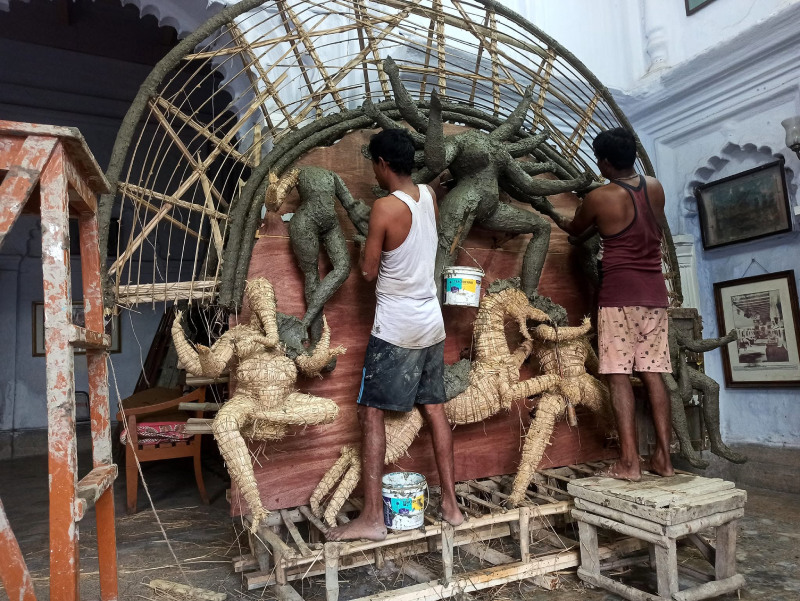
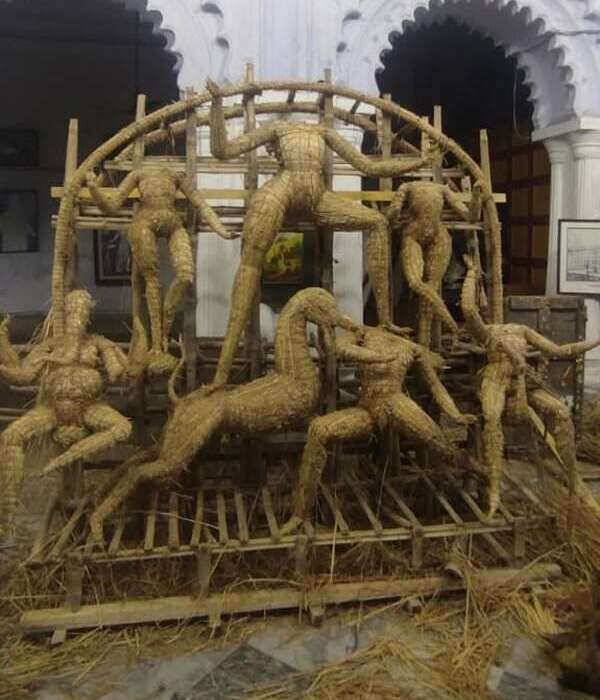
Kathamo Construction – Frame Setup

Artisans create the wooden and bamboo skeleton (Kathamo). Bamboo planks and posts are cut and tied with jute twine to establish the structural base for single deities like Ganesha, Kali, or Saraswati, or complex multi-deity compositions like Durga and Jagadhatri.

Kathamo Construction
02

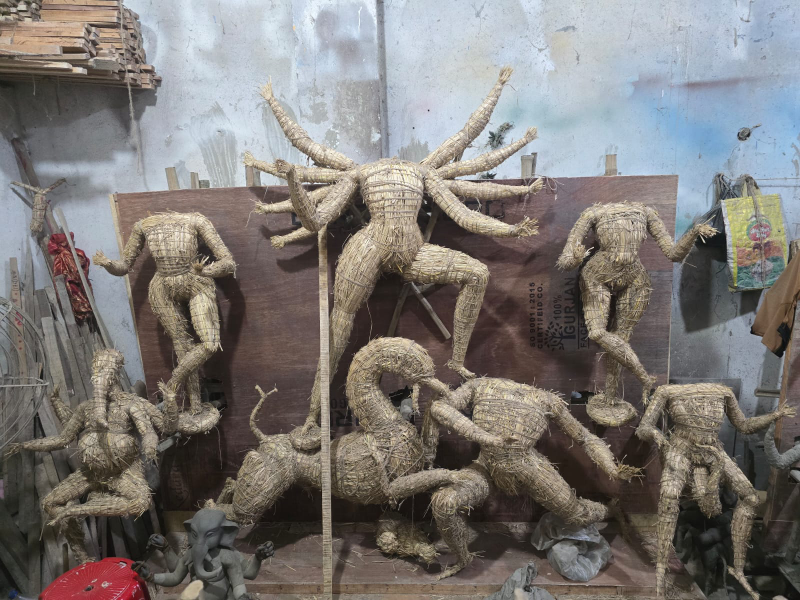
Khar Binda – Straw Bundling

Dry paddy straw is bound tightly around the bamboo framework using jute rope. This forms the rough anatomical contours and torso volume of the deity while keeping the idol’s core lightweight and sturdy.

Khar Binda
03

Etel Mati Application – First Clay Layer

The initial coat of sticky, heavy riverbed clay (Etel Mati) — blended with rice husk and the ritual Punya Mati — is applied over the straw base. This layer seals the straw frame and provides structural weight and cohesion.

Etel Mati Application
04

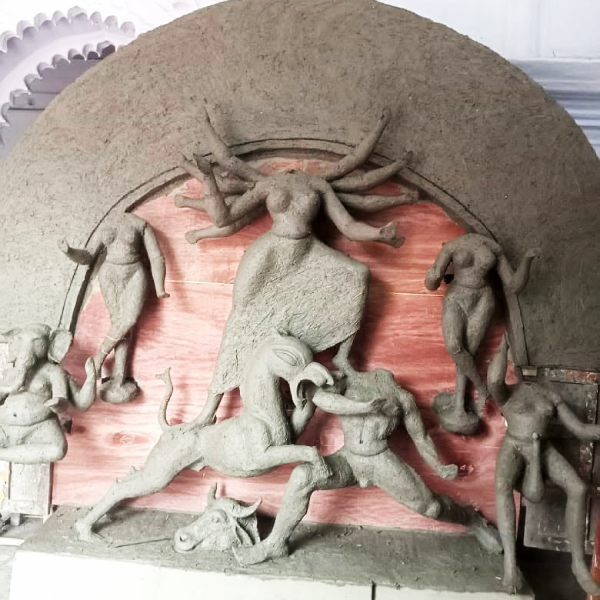
Bele Mati Coating – Fine Clay & Jute Layer

A finer alluvial soil (Bele Mati) mixed with shredded jute fiber is applied for surface modeling. Artisans smooth out muscle contours, limbs, facial structure, and drape folds. Jute fibers serve as natural tensile reinforcement to prevent surface cracking as the clay shrinks during drying.

Bele Mati Coating
05

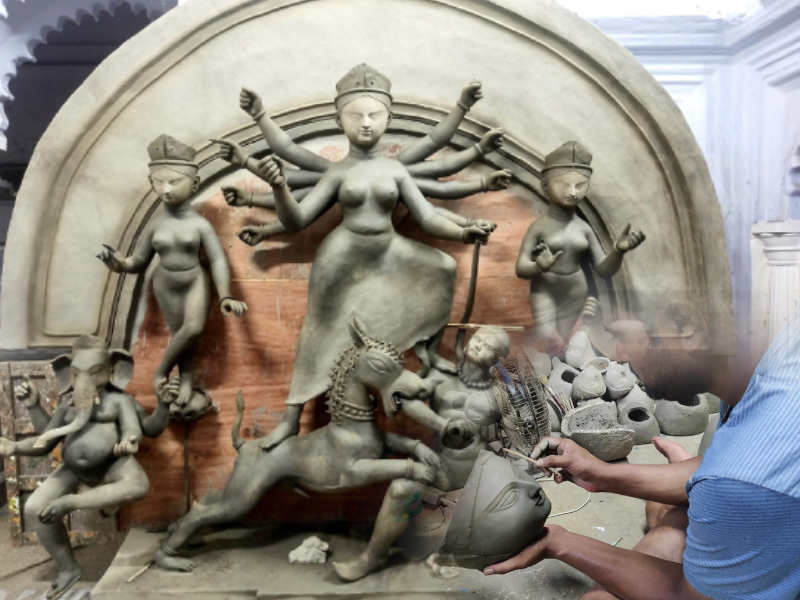
Mukh Porano – Attaching Head & Hands

Deity faces, hands, and intricate features are cast separately using clay and reusable plaster-of-Paris molds. Once semi-dry, the molded faces (Mukh) and hands are seamlessly fused to the torso using wet clay and jute ties.

Mukh Porano
06

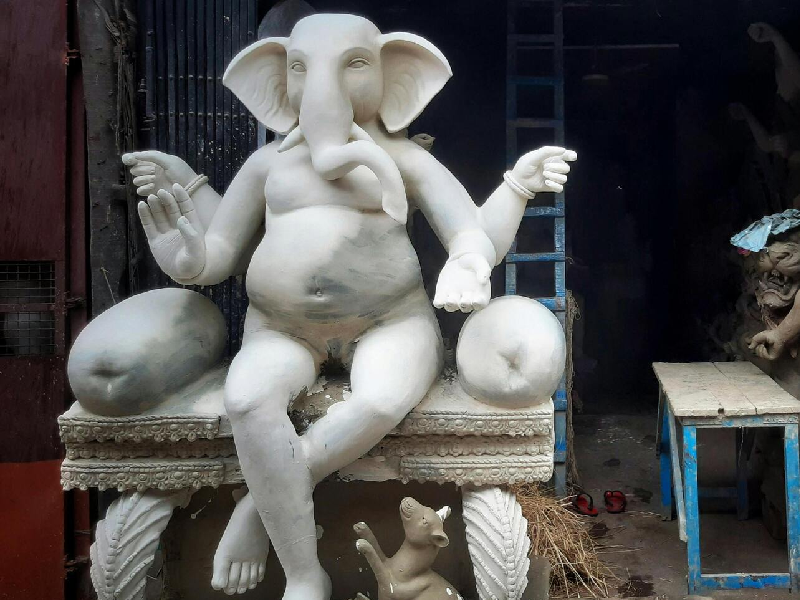
Khori Maati – Drying & Priming

The idols are left to air-dry naturally in Kumartuli’s workshops and lanes. Once moisture evaporates, a white chalk-clay wash (Khori Maati) mixed with natural tamarind seed glue or starch is painted over the idol as a sealer and base coat.

Khori Maati
07

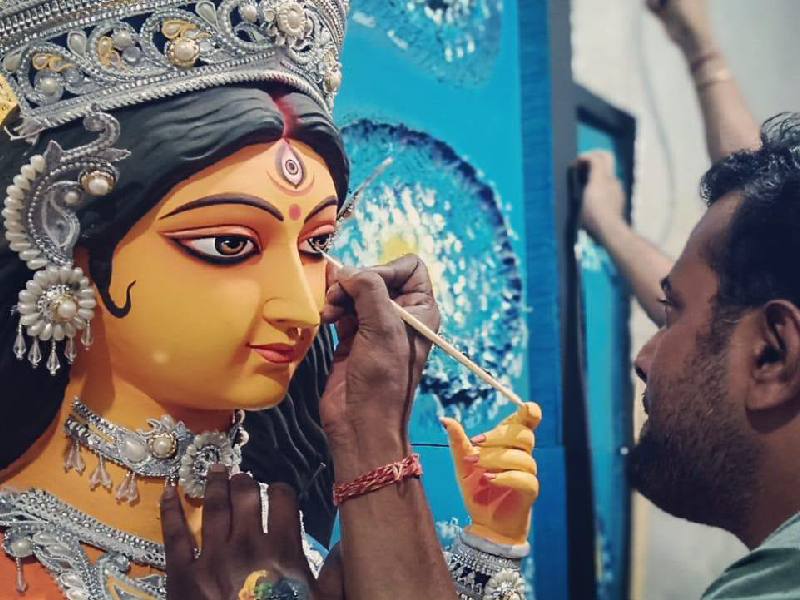
Rang and Chokh Daan – Painting & Eye Drawing

Artisans apply non-toxic, water-soluble paints to depict skin tones characteristic of specific deities (e.g., yellow/white for Saraswati, dark blue/black for Kali, golden yellow for Durga and Lakshmi). The process culminates in Chokh Daan — drawing the deity’s eyes — a sacred phase traditionally performed by senior artists in a state of ritual focus.

Rang and Chokh Daan
08

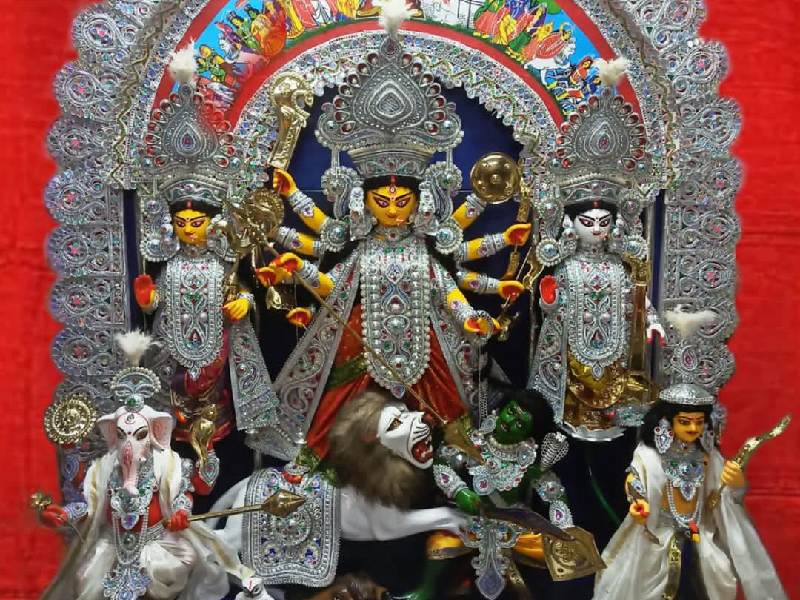
Saaj and Draping – Final Dressing

The completed deity is dressed in fabric sarees, silk garments, or traditional Sholar Saaj (intricate white cork work) and Daker Saaj (embossed metallic foil ornamentation). Painted jute hair is attached, along with crown structures (Mukut) and ceremonial weapons or iconic items (e.g., Saraswati’s Veena, Ganesha’s Modak, Kali’s Sword).

Saaj and Draping
Sacred Tradition

The Sacred Ritual of Punya Mati

An essential spiritual element of traditional idol sculpting in Bengal — sacred soil collected from distinct places is mixed into the primary clay before sculpting begins.

The ritual reflects an inclusive social philosophy — signifying that the divine mother or deity belongs to all strata of society without discrimination.

Sources of Sacred Soil

Before the active clay work begins, sacred soil collected from distinct places is mixed into the primary clay mixture. Traditionally, this includes soil gathered from:

  • 01 Banks of the Holy Ganga
  • 02 Cow shelters (Goshala)
  • 03 Palace gates
  • 04 Crossroads of four roads
  • 05 The doorstep of a Nishiddho Pallis (brothel quarter)

According to Hindu customs, when a person enters a brothel, they leave their purity and good virtues at the threshold; thus, the soil outside is considered purified by taking in those virtuous energies.
A priest or senior artisan formally blesses and mixes this soil with the primary river clay (Etel Mati) during the Kathamo Puja (frame worship) on auspicious days like Akshaya Tritiya or Ratha Yatra, spiritually sanctifying the raw materials before sculpting commences.
Your Questions Answered

Frequently Asked Questions

01 What materials are used in traditional Kumartuli idols?

Traditional idols use bamboo, wood, straw, jute, rice husk and alluvial clay from the banks of the Hooghly River. They are painted with non-toxic, water-soluble colours.

02 What is Punya Mati?

Punya Mati is sacred soil collected from the banks of the Ganga, cow shelters, palace gates, four-road crossroads and the doorstep of a Nishiddho Palli. It is blessed and mixed into the clay before sculpting begins.

03 What is Kathamo?

Kathamo is the wooden and bamboo skeleton on which the whole idol is built. It is blessed during Kathamo Puja.

04 What is Chokh Daan?

Chokh Daan is the sacred drawing of the deity's eyes. It is traditionally done by senior artists as the final step of painting.

05 Can I order a custom idol from Jatin Pal & Sons?

Yes. We craft idols to your size and style, finished in Sholar Saaj or Daker Saaj. Contact us on WhatsApp at +91 99331 67919 to discuss your requirements.

Festive Season Bookings

Reserve Your Custom Deity Idol

Bring home or to your pandal an authentic piece of Bengal’s heritage, crafted to your Custom Size & Style, finished in Sholar & Daker Saaj.

Contact the Kaushik Pal Guild today to discuss your requirements, request a quote, or finalize your booking before festival dates.

Contact Now WhatsApp Now